Starting with the current U.S. residency match cycle, all Emergency Medicine (EM) and Obstetrics & Gynecology (OBGYN) residency programs require applicants to submit applications exclusively through ResidencyCAS.
- Bhopal, Madhya Pradesh, India
- support@programinsider.in


How to Apply for Emergency Medicine and OBGYN Residency Using Residency CAS (IMG, USMLE & Residency Match Guide)
Residency Match Guide
How to Apply for Emergency Medicine and OBGYN Residency Using ResidencyCAS
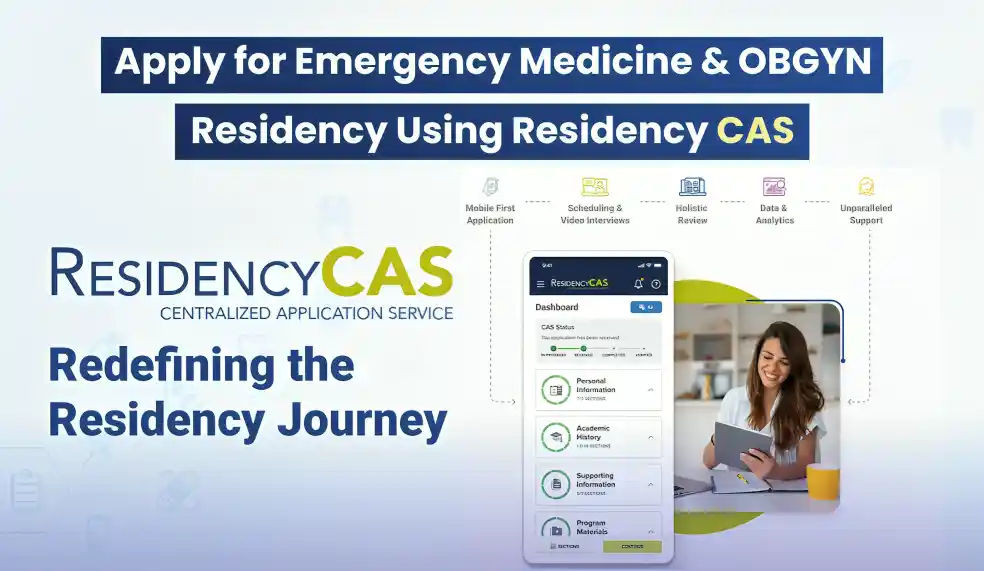
Applications for EM or OBGYN submitted through ERAS are no longer accepted and will not be reviewed, regardless of applicant type. This change affects U.S. MDs, DOs, and International Medical Graduates (IMGs) applying for the residency match.
This complete guide explains how ResidencyCAS works, who must use it, how IMGs obtain access, required USMLE documents, timelines, NRMP requirements, and common residency match mistakes.
Overview
What Is ResidencyCAS in the Residency Match Process?
ResidencyCAS (Centralized Application Service) is an official residency application platform used by selected specialties to manage:
- Residency match applications
- Applicant profiles and academic records
- Letters of Recommendation and SLOEs
- Program signaling
- Interview invitations and scheduling
For Emergency Medicine and OBGYN, ResidencyCAS has fully replaced ERAS as the mandatory application system.
Who Must Apply Through ResidencyCAS?
ResidencyCAS is required for all applicants applying to:
Emergency Medicine Residency
- Categorical EM programs
- Combined programs (EM-IM, EM-Pediatrics, EM-Anesthesia)
OBGYN Residency
- All categorical OBGYN programs in the United States
This requirement applies to:
- U.S. MD students
- U.S. DO students
- International Medical Graduates (IMGs) applying through ECFMG
Important for IMGs: You Cannot Self-Register on ResidencyCAS
Unlike ERAS, applicants cannot independently create a ResidencyCAS account.
U.S. MD / DO applicants
→ Access link is issued by the medical school or Dean's Office
International Medical Graduates (IMGs)
→ Access link is provided through ECFMG
Without this link:
- You cannot open a ResidencyCAS account
- You cannot apply for EM or OBGYN residency programs
IMGs should request access early, as delays can affect the entire residency match timeline.
Process
ResidencyCAS Application Steps (USMLE & IMG Friendly)
Step 1: Create Your ResidencyCAS Account
After receiving your official access link:
- Activate your account
- Set login credentials
- Confirm your email
You will then access your ResidencyCAS applicant dashboard.
Step 2: Enter Personal and Medical School Information
- Personal identification details
- Medical school or international medical graduate status
- Graduation year
- Degree type (MD, DO, MBBS)
Accuracy is critical, especially for IMGs and NRMP verification.
Step 3: Add Clinical Experience, Research & Activities
ResidencyCAS allows structured entries for:
- Core clinical rotations
- U.S. clinical experience (USCE) for IMGs
- Observerships and externships
- Research projects and publications
- Volunteer work and leadership roles
Concise descriptions improve readability during program screening.
Step 4: Upload Required Residency Match Documents
Applicants must upload or authorize the following:
Personal Statement
- Specialty-specific for EM or OBGYN
- Some programs allow multiple versions
Medical School Transcript
- Uploaded by the medical school or ECFMG for IMGs
MSPE (Dean's Letter)
- Required by most residency programs
- Uploaded by the medical school
USMLE / COMLEX Scores
- USMLE Step 1 and Step 2 CK (or COMLEX)
- Must be authorized and released properly
Step 5: Letters of Recommendation and SLOEs
ResidencyCAS supports:
- Traditional Letters of Recommendation
- Standardized Letters of Evaluation (SLOEs)
Emergency Medicine:
- SLOEs are essential and heavily weighted.
- Usually required from EM rotations
- Heavily weighted in EM residency match decisions
OBGYN:
- Many programs prefer at least one OBGYN-specific SLOE.
- Some accept traditional specialty letters
Letter writers upload letters directly to ResidencyCAS using a secure link.
Step 6: Program Selection and Submission
Once your profile is complete:
- Search EM or OBGYN residency programs
- Assign documents and USMLE scores
- Apply to selected programs
- Pay application fees
- Submit your application
⚠️Applications cannot be edited after submission.
ResidencyCAS Features
Program Signaling & Interview Management
Program Signaling in ResidencyCAS
ResidencyCAS allows applicants to indicate strong interest in selected programs.
- Limited number of signals
- Important for competitive residency match applicants
- Frequently used during initial application screening
Strategic signaling is especially helpful for IMGs and applicants with geographic preferences.
Interview Invitations and Scheduling
ResidencyCAS manages:
- Interview invitations
- Interview scheduling
- Program communication
Applicants must:
- Monitor email daily
- Check ResidencyCAS regularly
- Respond quickly to interview offers
Late responses may result in lost interview opportunities.
Timeline
ResidencyCAS Timeline (Residency Match Overview)
| Phase | Timeline |
|---|---|
| ResidencyCAS opens | June |
| Application preparation | June – September |
| Submission deadlines | Late September |
| Interview season | October – January |
| NRMP Rank Order List | February |
| Match Day | March |
Deadlines vary by program.
Residency Match Insights
Key Differences & Common Mistakes
ResidencyCAS vs ERAS vs NRMP
- ResidencyCAS → Application submission and interviews for EM & OBGYN
- ERAS → Used by other residency specialties
- NRMP → Residency match ranking and final Match Day results
All applicants must separately register with NRMP, submit a Rank Order List, and certify it.
Common Residency Match Mistakes
- Applying to EM or OBGYN through ERAS
- Delaying ResidencyCAS access (especially IMGs)
- Missing required SLOEs
- Not releasing USMLE scores
- Ignoring interview invitations
- Confusing ResidencyCAS with NRMP
Any of these errors can negatively affect residency match success.
Final Takeaway for Residency Match Applicants
ResidencyCAS is now the only application platform for Emergency Medicine and OBGYN residency programs in the U.S. Failing to adapt to this system change can result in missed interviews and lost residency match opportunities.
NEWS BLOGS
Read Our Latest Updates
Our blogs are the best way to get insights about programs and courses.
Call For More Info+91-7770938931