
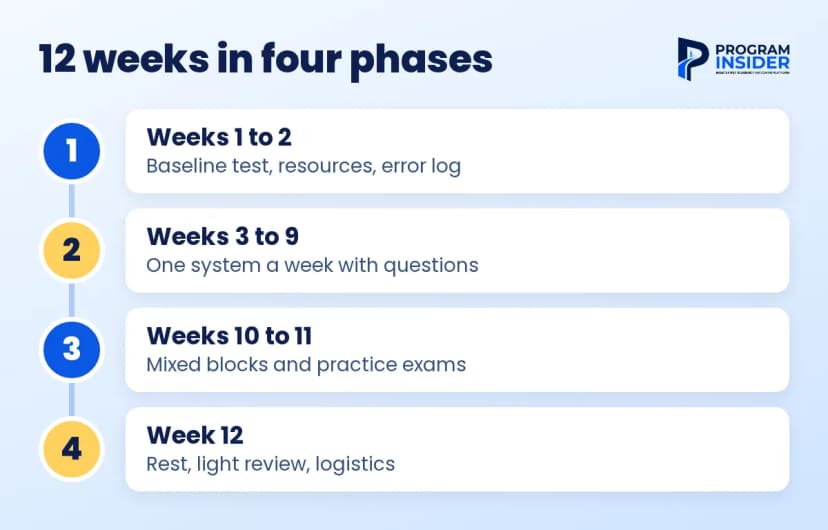
Quick answer: Split 12 weeks into four phases. Use weeks 1 and 2 for a baseline test and resources. Use weeks 3 to 9 for body systems with daily question blocks and error review. Use weeks 10 and 11 for mixed blocks and practice exams. Keep week 12 for rest, light review and exam day logistics.
A study plan has one job. It tells you what to do today, so you do not waste energy deciding. Most students do not fail Step 2 CK because they are lazy. They fail to plan because they study what feels good, not what raises the score.
This page gives you a full 12 week schedule for an international medical graduate (IMG). It shows daily hours, weekly review rules and what to cut if you are short on time. For ideas on raising your score once the plan is running, read our post on how to score higher in Step 2 CK.

Know the exam before you plan around it
Step 2 CK has sixteen 30 minute blocks in a 9 hour session, with 55 minutes of break time. The passing score is 218 for tests from 1 July 2025. Your plan must train two things: knowledge and stamina. Both need weeks, not days.
Step 1 is pass or fail now. That makes Step 2 CK the main number programs can see. So aim above the pass line, not on it. Our post on the timing of Step 1 and Step 2 CK can help you pick your exam month before you build the weeks.
| Group | Pass rate | Note |
|---|---|---|
| US MD first takers | 98% | Strong base |
| Non-US first takers | 90% | Most IMGs |
| Repeaters | 64% | Plan to pass once |
These are first try numbers from the USMLE performance data. They tell you one thing: the exam is passable, and a second attempt is much harder. A good schedule is your best way to pass on the first try.
The 12 week plan in one view
Here is the plan on a single page. Each phase has one main goal. If a phase goal is not met, you add days to that phase before you move on.
| Weeks | Main goal | Daily core work |
|---|---|---|
| 1 to 2 | Baseline and resources | Timed test, outline, mixed blocks, set error log |
| 3 to 9 | Body systems | One system a week, question blocks, error review |
| 10 to 11 | Mixed and exams | Mixed timed blocks, full practice exams, weak list |
| 12 | Rest and logistics | Light review, sleep, ID and travel check |
Weeks 1 and 2: baseline test and resources
Do not read a single chapter before you know where you stand. Start with a timed baseline test and the free official practice material. The official outline shows what the exam covers. The baseline shows what you do not know yet.
Week 1: find your starting point
- Day 1: read the official content outline and the free sample questions to see the question style.
- Day 2: sit one timed baseline test and record your score and your score in each subject.
- Days 3 to 7: do mixed blocks, review every wrong answer and start your error log.
Week 2: lock your tools
- Pick one question bank, one main review source and one note system. Do not add more.
- Rank your subjects from weakest to strongest and set the order of your systems weeks.
- Book or confirm your exam date, then count back to see your real calendar.
Example: Asha scores low in obstetrics and pediatrics on her baseline, and high in internal medicine. She puts her two weak systems in weeks 3 and 4, when her energy is highest. She leaves her strong subject for a lighter later week. Same hours, better use.
Weeks 3 to 9: one system a week
This is the heart of the plan. Pick one body system for each week. Learn it through questions first, then fill gaps by reading only what the questions show you missed. Questions teach faster than long reading, because every wrong answer points at a gap.
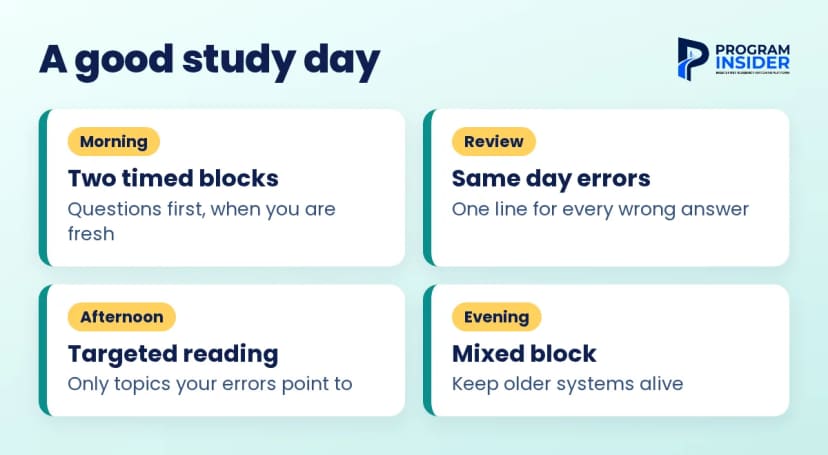
A simple daily rhythm
- Start with two timed question blocks of your system, in the morning when you are fresh.
- Review each block the same day. Write one line for every wrong or guessed answer.
- Read only the topics your errors point to, for two to three hours.
- Do one mixed block of older systems so you do not forget them.
- End with ten minutes on your error log and set tomorrow's first task.
That rhythm fits in about eight to ten hours with real breaks. Keep one evening a week light. Your brain stores new facts during rest, and a tired mind makes the same mistakes twice.
The weekly review rule
Keep one half day each week, for example Sunday morning, only for review. Redo the questions you got wrong that week and re-read your error log. Then take one mixed timed set to check that the system really sticks. Do not skip this half day, even when you feel behind.
- Read for six hours, do a few questions at night and never look at the wrong answers again.
- Switch systems on a whim when a topic feels hard, so nothing gets finished.
- Start each day with timed questions, review them the same day and log every error in one line.
- Finish the system, take a mixed set on Sunday and carry the weak topics into next week.
Want a plan built around your exam date?
Tell our team your date and your baseline score. Our Step 2 CK service helps you set weekly targets and review rules.
Weeks 10 and 11: mixed blocks and practice exams
On the real exam, systems are mixed. Questions do not come labelled. So the last phase trains you to switch fast. Do mixed timed blocks every day, and take full length practice exams in these two weeks. Use the same start time as your real exam slot.
- Take one full practice exam early in week 10 and another early in week 11.
- Copy the real day: sixteen blocks of 30 minutes with about 55 minutes of break.
- Review the exam over the next day, not the same night, when your mind is tired.
- Sort every error by reason: missed fact, misread question, wrong next step or rushing.
- Build a short weak list of five to eight topics and drill only those.
Example: After his first practice exam, Dev sees that most of his errors are not facts. He picked the right diagnosis but the wrong next step. For three days he drills management questions only. He retests and his weak list gets shorter. That is the point of this phase.
Read our exam day time management post in week 11. It shows how to pace each block and what to do with your break, so the long session does not drain you.
Week 12: rest, light review and exam logistics
Week 12 is not for new topics. Your score is mostly set by now. Use this week to protect it. Sleep on a fixed schedule. Review your error log and weak list for two to three hours a day. Take at least one full day off.
- Check your scheduling permit, exam date and test center time in your official account.
- Pack the ID that matches your registration name, and check the center rules on the official site.
- Plan your travel and test the route, then add buffer time for delays.
- Plan your break foods and drinks so you do not decide on exam day.
- Set two alarms and sleep early on the night before.
Check the exact rules for ID and items in the USMLE bulletin information. Rules can change, so read the current page, not an old forum post.
What to cut if you have fewer than 12 weeks
Not everyone has 12 free weeks. If you have less, do not squeeze everything. Cut in this order and protect your daily questions and error review above all.
| Cut this | Keep this | Why |
|---|---|---|
| Second reading of strong subjects | Questions on weak subjects | Weak subjects give more points per hour |
| Long notes and rewriting | One line error log | Short notes get reread, long notes do not |
| One systems week, merge two small ones | Weekly review half day | Review is where memory is built |
| A new resource mid plan | Your chosen resource | Switching costs days and adds no score |
If you work, run the same plan over more weeks with shorter days. Two or three hours on a work day plus a long weekend can work. Do not cut the practice exam phase, even then. Stamina for a 9 hour session only comes from practice.
Mistakes that break a good schedule
Skipping the baseline
Without a first test, you guess your weak subjects. You may spend two weeks on topics you already know and miss the ones that cost you the most points.
Collecting too many resources
Each new book or video adds hours and doubles your notes. Pick one question bank and one main review source in week 2, and finish them before you add anything.
Reading without questions
Long reading feels safe, but it does not test you. Questions show what you can recall under time pressure. Start every day with questions and read second.
Reviewing errors too late
If you wait until the weekend to review, you forget why you chose the wrong answer. Review each block the same day while the stem is fresh in your mind.
Taking practice exams too early or too late
An exam in week 3 only tells you what you already know. An exam in the last days leaves no time to fix anything. Take them in weeks 10 and 11.
Studying hard in week 12
Cramming in the last week raises stress and lowers sleep. Both can hurt your score on exam day. Use this week to rest and check your logistics.
Your next seven days
Get your Step 2 CK plan checked
Our Step 2 CK service helps you build weekly targets and review rules. If you also need a rotation or a full match plan, see our complete match plan.
Sources
- USMLE
- USMLE: Common questions
- USMLE: Performance data
- USMLE: Prepare for your exam
- USMLE: Bulletin of Information
Last checked on 25 November 2026. Plans, examples and sample messages are our general advice, not official rules. Dates and fees can change, so check the official source before you act. No provider can guarantee a letter, an interview or a Match.