
Quick answer: To score higher on Step 2 CK, start with a timed diagnostic test. Find your weak subjects, then run question bank cycles with careful error review. Add timed full length practice exams every few weeks. Use the last two weeks only for your weak list and exam day practice, not new reading.
Step 1 is pass or fail now. Step 2 CK is the only USMLE Step that shows a number. Programs can read it, compare it and use it. For an international medical graduate (IMG), that changes the goal. You are not just trying to pass. You are trying to put up a score that makes your whole file stronger.
This post is about raising your score, not about the exam format. For the block count, the passing score of 218 and a basic study plan, read our Step 2 CK format and study plan post. This page picks up where that one ends and shows how to turn steady daily work into real points.

Why the diagnostic test comes first
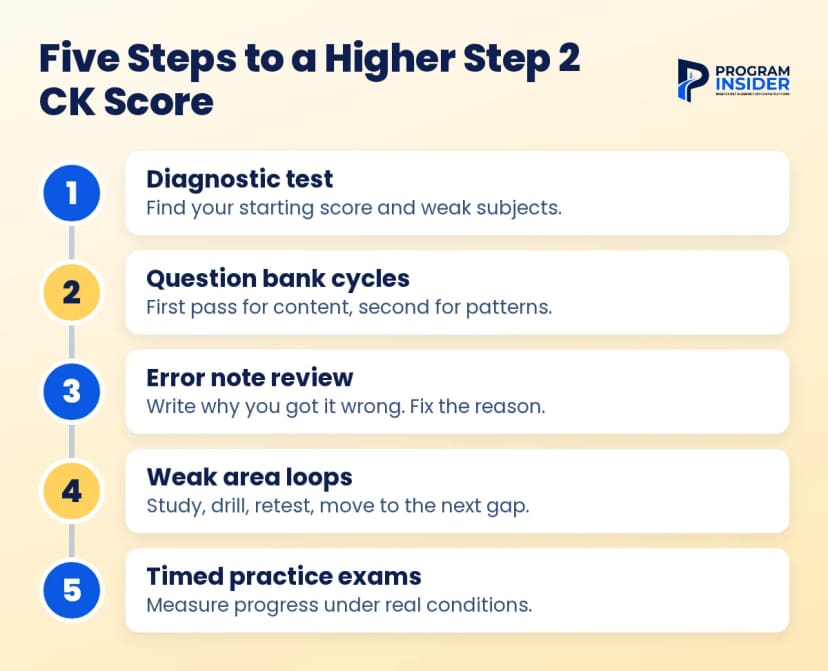
Many students open a question bank on day one and start from the first chapter. That is a mistake. A diagnostic test, done under timed conditions, tells you two things. It tells you where you stand right now. And it shows the exact subjects pulling your score down.
Use the free official practice materials to see the real question style. Then sit a full timed diagnostic from your question bank. Write your score and how well you did in each subject. This sheet becomes your map for the weeks ahead.
Example: Priya sits a diagnostic test on day one. She scores just over half overall, with under half right in OBGYN and nearly three out of four right in internal medicine. Without the test, she would have started with internal medicine because she felt weak there. The results show the opposite. OBGYN is her real gap, so she puts it first and gains more points per hour.
How question bank cycles raise your score
One pass through a question bank teaches you content. A second pass, done only on the questions you got wrong or guessed, teaches you patterns. The real score jump usually comes on the second pass, not the first. Treat the first pass as a way to build your list of traps.
- Complete the full question bank once, subject by subject, under timed mode.
- Mark every wrong answer and every answer you guessed right.
- Start a second pass using only your marked and wrong questions.
- Group your second pass errors by the reason you missed them, not only by topic.
- Fix the top mistake pattern first, then retest that group a few days later.
Most students do only one pass. They feel they have seen the questions, so they move on. But the first pass has low retention for wrong answers. The second pass is shorter, faster and much more useful for raising your score.
Reviewing wrong answers the right way
Reading the explanation is not enough. You need to write why you picked the wrong choice and what clue you missed in the stem. Keep each note short, five lines or fewer, so you will actually read it again before exam day.
Example: Rahul reviews forty error notes after week three. He sorts them by reason. Eighteen notes say he picked the right diagnosis but chose the wrong next step. Nine say he missed a drug side effect. He does not need a new book. He needs to practise management steps and drug tables. Two targeted fixes cover half his errors.
- Read the full explanation once, nod along and move straight to the next block.
- Save all your wrong question notes and read them only the night before the exam.
- Sort every mistake only by the calendar date instead of the reason you missed it.
- Write one short line on why you picked the wrong choice and what clue you missed.
- Revisit each error note three days later so the rule sticks in active memory.
- Group your notes by error type and fix your top recurring mistake pattern first.
Build a weak area loop that works
A weak area loop is simple. Pick the subject with your lowest score. Study its core management rules for a few days. Do a small timed set of questions in that subject and check your new score. If it went up, move to the next weak subject. If it stayed flat, check your error notes again before moving on.
Day 1 to 2: Pick a weak subject
- Find the subject with the lowest diagnostic result.
- Review the core clinical rules and algorithms in that subject.
Day 3 to 5: Question drills
- Run timed blocks in that subject only.
- Write short error notes for every wrong or guessed answer.
Day 6: Retest
- Take a fresh timed set in that subject.
- Compare your result and pacing against day one.
Day 7: Move or repeat
- Move to your next weak area if the score rose clearly.
- Fix the top error pattern again if the score stayed flat.
This one week loop is fast. You can run it three or four times in a month. Each loop closes one real gap instead of letting you hide in topics you already know. Your score rises because every study hour goes straight where the lost points sit.
When and how to use practice exams
A practice exam is not a study tool. It is a measuring tool. Use it to check whether your study plan is working. Take one after every three to four weeks of study. Sit it under real conditions: full time, no phone, planned breaks.
The USMLE Step 2 CK format has sixteen blocks of 30 minutes each, in a nine hour session, with at least 55 minutes of break time. Train your body for that length. Many students lose points in the final blocks because they never practised sitting that long.
| Practice exam | Purpose | What to check |
|---|---|---|
| First (week 1) | Diagnostic, find weak areas | Subject scores, not overall score |
| Second (week 4) | Check early progress | Did your weakest subject improve? |
| Third (week 8) | Full length under time | Stamina, pacing and score trend |
| Fourth (week 10 to 11) | Readiness check | Is the score steady and above your target? |
Example: Meera sits her third practice exam at week eight. Her first twelve blocks go well, then her accuracy drops sharply in the last four blocks because she skipped lunch. She does not add another textbook. Instead, she builds a fixed snack and water break every two blocks and sits a full nine hour dress rehearsal in week ten. Her late block drop disappears.
If your practice scores go up and down each week, you are not ready. A steady score over two tests in a row is a better signal than one high score followed by a drop. For more help on pacing, read our guide to exam day time management.
Need a study plan built for your exam date?
Share your diagnostic score and your weak subjects. Our Step 2 CK support gives you a clear plan, weekly check ins and practice exam timing to keep your score rising.
The last two weeks before the exam
The last two weeks are not for new chapters or new question banks. They are for sharpening what you already studied, locking in high yield error rules and training your exam day habits. Calm focus beats late cramming every time.
- Review only your error notes and weak area summaries.
- Do two to three timed blocks a day, all mixed subjects.
- Take one full length practice test at the start of this period.
- Practise your break plan with real food and real timing.
- Stop studying the evening before exam day.
- Pack your bag, check your route and sleep early.
The urge to read new chapters in the last week is strong. Fight it. New facts at this stage confuse more than they help. Trust the work you did. The last two days should feel calm, not frantic.
How programs read your Step 2 CK score
Since Step 1 moved to pass or fail on 26 January 2022, Step 2 CK is the only USMLE Step that gives a number. That number sits in your Electronic Residency Application Service (ERAS) file next to your letters, CV and personal statement. Some programs may use it to screen applications.
A higher score does not promise interviews. No one can promise that. But it removes one reason to be screened out. It also helps when you shortlist programs, because you can compare your file against official National Resident Matching Program (NRMP) reports on nrmp.org. You can then pick places with our program shortlisting service.
| Group | Pass rate | Note |
|---|---|---|
| US MD first takers | 98% | Very high bar |
| Non-US first takers | 90% | Strong first time |
| Non-US repeaters | 64% | Pass harder on retake |
These numbers come from USMLE performance data. The gap between first takers and repeaters is large. If you are not ready, move your date. The exam fee is $695, but a failed attempt costs far more in time and in how your file looks.
The NRMP publishes reports like Charting Outcomes and the Program Director Survey that show how scores fit alongside research, letters and clinical experience. Read those reports on nrmp.org for the real numbers, then use them when you plan your specialty list.
Common mistakes that keep your score low
Reading without doing questions
Reading feels safe and steady. The exam tests clinical choices under tight time, not recall. Start timed blocks in week one, even if early scores feel poor.
Skipping the diagnostic test
Without a starting baseline score, you cannot tell which subjects hurt you most or whether your plan works. Sit a timed diagnostic test before you study.
Doing only one question bank pass
The first pass teaches basic content. The second pass on marked and wrong questions teaches test patterns. Skip the second pass and your score often stays flat.
Studying new material in the last week
Opening new chapters in the final days creates doubt and fatigue. Use the last week only for your error notes, weak list and short mixed timed blocks.
Ignoring exam day stamina
A nine hour test day is long. If you never sit for that full length in practice, your focus and score will drop in the last four blocks.
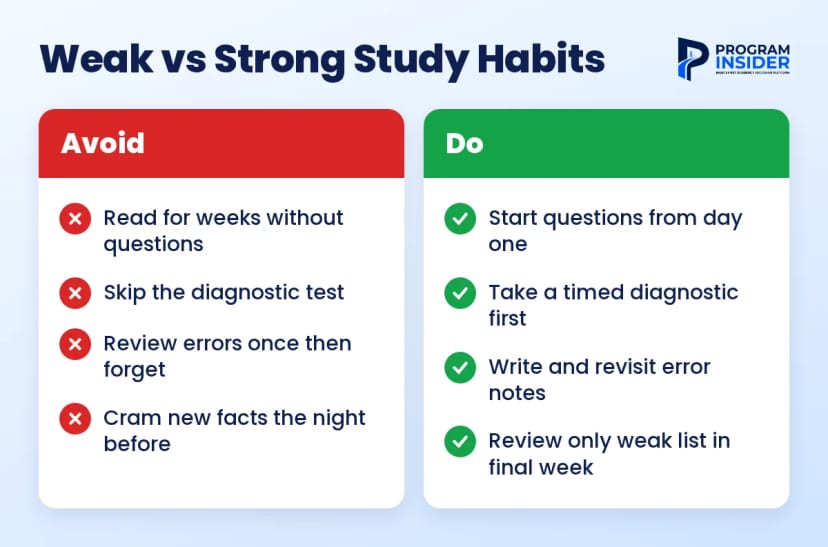
Even strong test takers lose easy points from rushing the first five questions or changing answers at the end. Read our guide on common mistakes during USMLE exams to spot those habits early, and ask our team about Step 2 CK preparation if your scores feel stuck.
What to do after the exam
Once you have your score, put it to work. Build a realistic list with our program shortlisting service, plan US clinical rotations for strong letters, and refine your personal statement. If you want everything lined up together, explore our complete Match plan.
Turn your Step 2 CK score into interviews
Share your exam date, score target and specialty goals with our team. Start with our Step 2 CK support and build your list through program shortlisting.
Sources
- USMLE
- USMLE: Performance data
- USMLE: Prepare for your exam
- USMLE: Bulletin of Information
- NRMP: Match data and reports
Last checked on 25 November 2026. Plans, examples and sample messages are our general advice, not official rules. Dates and fees can change, so check the official source before you act. No provider can guarantee a letter, an interview or a Match.