Quick answer: Pick a US clinical rotation that matches your target specialty, offers direct supervision and ends with a real letter uploaded to ERAS. Choose hands-on care when eligible and compare hospital settings honestly. Verify total costs and visa rules in writing, then use clear filters to compare options.
Many international medical graduates treat US clinical experience (USCE) like a stamp to collect. They book whatever spot opens first, spend thousands in travel and walk away with a generic two paragraph letter.
A smart rotation choice does the opposite. It shows residency programs that you know how US clinics run and work well in a team. Better yet, it gives a US doctor real reasons to vouch for your patient care.

Start with your target specialty
Your rotations should tell one clear story about the residency you want. If you plan to apply in internal medicine, your strongest US letters should come from internal medicine doctors.
Subspecialty electives in cardiology or nephrology still count as internal medicine exposure, because they sit under the same umbrella. By contrast, three surgery letters rarely help an internal medicine application.
If you are applying to a backup specialty as well, split your rotations on purpose. Get dedicated letters for each specialty, because ERAS lets you assign up to four letters per program. Read our guide on planning clinical rotations in the United States to map your mix.
Example: Priya is an example graduate aiming for internal medicine. A friend offers her a cheaper neurology observership in May, while a community internal medicine externship opens in June. She picks the June internal medicine spot, because an internal medicine letter of recommendation (LOR) fits her target program list directly.
Hands on work vs observerships
Not all rotations give you the same role with patients. Your eligibility also changes the day you graduate from medical school.
Final year students at participating schools can apply for hands-on electives through Visiting Student Learning Opportunities (VSLO), run by the AAMC. Each elective application costs about $18, and graduates cannot use VSLO.
Once you graduate, many university hospitals limit you to shadowing. Some clinics and community hospitals still offer hands-on externships where you take histories, examine patients under supervision and draft notes. Read non-VSLO clinical electives and myths about observerships and hands-on clerkships before you decide.
| Rotation type | Who can apply | Patient role | Letter strength |
|---|---|---|---|
| VSLO elective | Current students at member schools | Full student role under supervision | High when you work with one team |
| Hands-on externship | Students and eligible graduates | History, exam and note drafting | Strong if attending checks your work |
| Inpatient observership | Students and graduates | Shadowing rounds and case talks | Moderate, depends on daily engagement |
| Outpatient clinic rotation | Students and graduates | Varies by clinic and state rules | Strong when doctor sees you daily |
Do not treat every hands-on label as equal. Ask what you will actually do each morning before you book.
Academic, community or clinic setting
Where you rotate shapes both what you learn and who signs your letter. Each setting brings a clear trade-off.
- Consider academic hospitals for complex cases, research contacts and recognizable letterhead, knowing graduates often get shadowing only.
- Choose community teaching hospitals when you want inpatient ward flow alongside residents and program faculty.
- Pick busy outpatient clinics when you want direct patient interviews, close mentorship and one doctor watching your growth every day.
A balanced plan mixes settings when possible. One inpatient rotation shows you can handle ward admissions and handoffs, while a strong clinic rotation can produce your most personal letter.
- Rotate in a random specialty because the spot was easy to book.
- Shadow in a crowded group where the doctor barely learns your name.
- Pick a famous hospital name with zero chance of an inpatient letter.
- Match the specialty directly to your ERAS or ResidencyCAS target.
- Work closely with one attending who hears your daily presentations.
- Confirm the setting fits your budget, timeline and hands-on goals.

Pick faculty who can write real letters
A famous name on a generic letter helps less than a detailed letter from an attending who actually saw your clinical thinking. Some programs read letters closely to see how you communicate with patients and staff.
Before you commit, check how the doctor works with rotators. Will you present patients, ask questions on rounds and get feedback mid-way through the month? Those moments give the writer real examples to put on paper.
Know the official upload rules from the AAMC letter writers guide and letter writers FAQ. You create the request in MyERAS, and the writer gets a secure email link to upload as a guest. The writer sends it, not you, and requests sent before June 2026 and never filled must be sent again.
Ask early whether the preceptor uses hospital or clinic letterhead and uploads directly to the AAMC portal. Our post on strong letters of recommendation from US clinical rotations shows how to earn specific praise during those four weeks.
Filter verified US rotations now
Browse Program Insider US clinical rotations by specialty, LOR type, state, setting and price. Need personal guidance on your timeline? Reach out on our contact page.
Check state, visa rules and full cost
Many applicants look only at the rotation fee and get surprised by everything around it. Build the full picture before you pay.
Look at state location first. Rotating in a state where you have family or affordable short-term housing cuts living costs fast. It can also help you learn the patient mix in regions with many residency programs.
Next, check visa requirements for the rotation itself. Ask the host site in writing what visa status they accept for your exact duties. Keep residency visas separate too. ECFMG, now part of Intealth, is the only J-1 sponsor for foreign doctors in US clinical training. Note that J-1 doctors face a two year home country rule unless waived.
Some residency programs sponsor H-1B instead, though a $100,000 payment rule for certain new petitions was announced in September 2025 and remains in flux. Always check the current status with the program and an immigration lawyer.
Example: Arjun is an example applicant choosing between two four-week internal medicine rotations. Site A charges a lower tuition fee in a high-rent city with no nearby transit and offers only shadowing. Site B costs slightly more in tuition, sits near his cousin's home, includes malpractice guidance and gives daily patient presentations. Adding rent and travel makes Site B cheaper overall and much stronger for his file.
- Updated medical CV with clear dates and duties
- USMLE Step 1 and Step 2 CK score reports, if taken
- Medical school transcript, enrollment letter or diploma
- Immunization records, TB test and drug screen if requested
- Proof of malpractice coverage or site coverage terms
- Valid passport and visa page matching site rules
- Written confirmation of dates, duties and refund policy
Plan duration and ERAS timing early
Four weeks per rotation is a practical standard. Two weeks rarely lets an attending watch your progress. At the same time, repeating the exact same clinic for many months adds less value than varying your clinical settings.
Work backward from the ERAS residency timeline. For the 2027 Match season, MyERAS opened 4 June 2026 and ECFMG access tokens for IMGs opened 24 June 2026. Applicants could submit from 2 September 2026, and programs began review on 23 September 2026. The 2028 dates are not published yet, though they usually follow a similar pattern, so check AAMC.
6 to 9 months before submission
- Lock your target specialty and check Step exam timing.
- Shortlist rotation slots and gather vaccines and transcripts.
Spring to July
- Complete two to three four-week rotations across inpatient and clinic settings.
- Open MyERAS when it launches and confirm each doctor's upload email.
August
- Finish final rotations and send polite reminders for pending letters.
- Polish your ERAS CV and build your residency program shortlist.
September
- Submit ERAS before programs begin review.
- Assign up to four matching letters per program.
Finishing your rotations by August gives your doctors breathing room to write and upload. Rushing a rotation in late September leaves your file incomplete when review starts.
Questions to ask and red flags to skip
Never wire a deposit based on a phone call or a vague flyer. Send a short email first and keep the answers in writing.
Example: Compare two replies to question one. A weak reply says, "We have a lively group of learners each month." A clear reply says, "At most two rotators join Dr. Patel on morning rounds, and you present two new patients daily." Always choose clarity over hype.
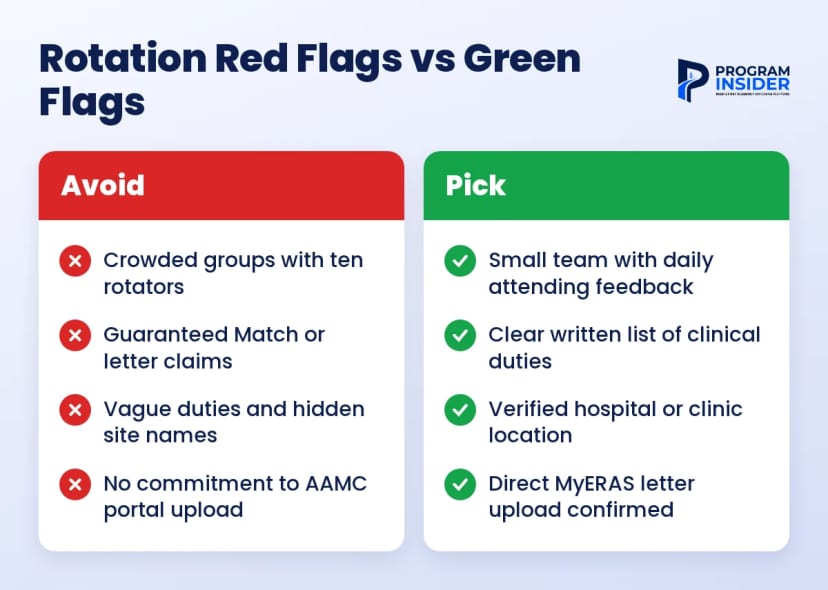
Crowded rotator groups
When ten students follow one doctor, nobody gets real feedback on patient care. Always ask for the exact rotator cap before you pay.
Guarantees for sale
No ethical program or agent can promise an interview, a Match or a glowing letter. Walk away whenever someone sells guaranteed outcomes.
Hidden third-party addresses
If a listing hides the hospital or clinic setting until after payment, you cannot verify who supervises you. Ask for the site first.
Unclear letter upload
A paper letter handed directly to you carries less weight and breaks ERAS flow. Confirm direct AAMC portal upload before booking.
Surprise extra fees
Malpractice insurance, hospital badges, vaccines and drug screens add up quickly. Ask for a full itemized cost list before sending any deposit.
Use the rotation filters to decide fast
Once you know what you need, searching random forums wastes weeks. Open Program Insider's US clinical rotations page and narrow the list in minutes using five filters.
- Filter by specialty first so every option matches your residency goal.
- Select LOR type next to focus on sites aligned with the letter strength you need.
- Pick your preferred setting, whether hospital inpatient, outpatient clinic or combined.
- Choose states where housing, travel or regional programs fit your plan.
- Sort by price last, after confirming that quality and supervision meet your bar.
Rotations work best when they connect directly to your ERAS timeline and target program list. Once your dates are set, our complete Match plan helps you align rotations, exam scores, CV entries and program shortlisting into one calendar.
Choose your rotation with confidence
Compare verified US clinical rotations by specialty, LOR type, state, setting and price today. Pair your rotations with our complete Match plan to stay ready for ERAS.
Sources
- AAMC: Visiting Student Learning Opportunities
- AAMC: ERAS letter writers
- AAMC: ERAS letter writers FAQ
- AAMC: ERAS residency timeline
- ECFMG: Certification
- US Department of State: J-1 Physician program
Last checked on 25 November 2026. Plans, examples and sample messages are our general advice, not official rules. Dates and fees can change, so check the official source before you act. No provider can guarantee a letter, an interview or a Match.