

How to Get Strong Letters of Recommendation During Your US Clinical Rotations

Quick answer: You get a strong US letter of recommendation by working closely with one attending for about four weeks, asking for feedback early, showing that you used it, and then asking in person for a strong letter before your last day. Send the writer a short packet the same day, then send the request through MyERAS.
Most IMGs think the rotation itself earns the letter. It does not. A rotation only gives you a chance to be noticed. The letter comes from what one doctor can honestly say about you at the end of it.
This guide shows you how to choose the right rotation, what to do each week, how to ask, and how the letter reaches programs under the new 2027 system.
What you will find here
- Why letters matter so much
- What makes a letter strong
- How to choose a rotation that can lead to a letter
- Your week by week plan
- How to ask, with a sample message
- How letters are sent for the 2027 season
- How many letters you need, and from whom
- Mistakes that weaken a letter
Why letters matter so much
The National Resident Matching Program asked program directors how they choose who to interview. In its 2026 survey report, letters in the specialty sat almost level with exam scores.
| What directors used to pick interviews | Directors who used it | Importance out of 5 |
|---|---|---|
| USMLE Step 2 CK score | 89% | 4.0 |
| USMLE Step 1 pass | 87% | 4.4 |
| Letters of recommendation in the specialty | 86% | 4.0 |
Notice the words "in the specialty". A kind letter from the wrong field helps far less than a clear letter from the field you are applying to.
What makes a letter strong
A strong letter gives proof. A weak letter gives compliments. Read the two lines below as if you were a program director.
- Weak: "The doctor was punctual, polite and hard working."
- Strong: "On a patient with new kidney injury, the doctor found the drug that caused it, explained the plan clearly and followed up the next morning without being asked."
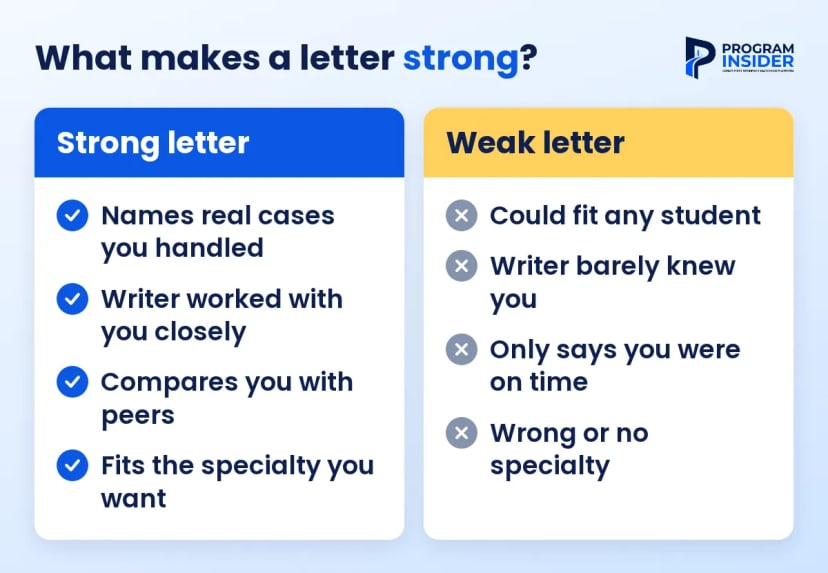
Your job during the rotation is to give your attending moments like that second line. They can only write what they saw.
How to choose a rotation that can lead to a letter
Check these points before you pay for any rotation:
- Same specialty. Rotate in the field you plan to apply to.
- One main attending. If you change doctors every few days, nobody knows you well enough to write.
- Enough time. We suggest four weeks with the same attending. One or two weeks is rarely enough for real examples.
- Your real role. Know if it is hands on or an observership. An honest letter can only describe what you were allowed to do.
- Letter type. Ask whether the attending writes letters, and whether it comes on hospital or clinic letterhead.
- Recent experience. Pick dates close to your application, so the writer still remembers you.
A paid rotation should never mean a guaranteed glowing letter. A good provider gives you access to the right doctor. You earn what the doctor writes.
Compare rotations by letter type
Every listing on our US clinical rotations page shows its letter type, specialty, state, setting and price. Use the LOR Type filter to see only the rotations that fit your plan.
Your week by week plan
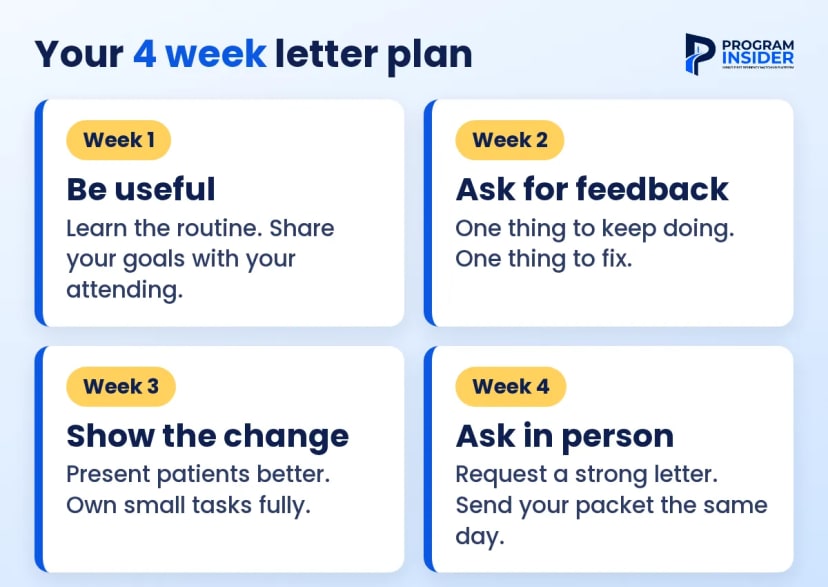
Week 1: Be useful and make your goal known
- Arrive early, learn how the team works and read about every patient on the list.
- Tell your attending your goal in one line: "I am applying to Internal Medicine and I want to learn how to present well."
- Keep a small daily log of cases and what you learned. Never write patient names or any detail that can identify a patient.
Week 2: Ask for feedback
- Ask two simple questions: "What should I keep doing? What is one thing I should fix?"
- Write the answer down and start on it the next morning.

Week 3: Show the change
- Let your attending see the fix. If they asked for shorter presentations, give shorter presentations.
- Read one good paper on a patient problem and share the main point in two minutes.
- Own small tasks fully, within what your role allows.
Week 4: Ask for the letter
- Ask in person, three to five days before you finish.
- Ask for a short review of your whole rotation first. If the review is warm, ask for the letter.
- Send your packet the same day, while you are fresh in their mind.
How to ask, with a sample message
Ask for a strong letter, not just a letter. That one word gives the doctor a polite way to say no. A polite no is better than a weak letter.

Say this in person:
"Doctor, I have learned a lot from you this month. I am applying to Internal Medicine. Do you feel you know my work well enough to write a strong letter for my residency application?"
Then send this email the same day:
Subject: Letter of recommendation, [Your name], [Rotation dates]
Dear Dr. [Last name],
Thank you for agreeing to write my letter. I rotated with you from [date] to [date] and I am applying to [specialty] for the [year] Match.
I have attached my CV, my draft personal statement and a one page list of cases I worked on with you. You will get a secure email link from AAMC to submit the letter. It would help me to have it by [date].
Thank you again for your time and teaching.
[Your name], [AAMC ID], [phone]
Your packet should have five things:
- Your updated CV. Our ERAS CV guide shows what to include.
- Your draft personal statement. If it is not ready, see our personal statement service.
- A one page list of cases and tasks, with no patient details.
- The specialty you want, spelled out clearly.
- A friendly deadline that is at least three weeks away.
Never write your own letter for a doctor to sign. Give facts and let them use their own words.
How letters are sent for the 2027 season
The old letter portal is gone. From the 2027 season, writers use the AAMC Letter Writer Portal. The steps are simple:
- You create the letter request in MyERAS with the writer's correct name and email.
- The writer gets a secure link by email. They can upload as a guest, with no account needed.
- The letter goes to AAMC. The letter belongs to the writer, so they send it, not you.
- You choose which programs get which letter in MyERAS.
Three details from the official FAQ catch people out. Requests made before June 2026 that were never filled have to be sent again. Letters that were already uploaded in the old portal were moved across. And if your field uses a standard form letter, you must pick the correct specialty when you make the request.
The request also asks whether you waive your right to view the letter. We suggest that you waive it, because it tells readers the doctor wrote freely. It is your choice.
A letter can arrive after you apply. But programs started reviewing 2027 applications on 23 September 2026, so a late letter may miss the first look. If you are planning for the 2028 Match, finish your key rotations well before the summer of 2027. Our ERAS 2027 timeline helps you plan.
How many letters you need, and from whom
You can assign up to four letters to each program. Each program sets its own number, so read its page. A safe mix for most IMGs:
- Two letters from US doctors in your specialty.
- One letter from another US doctor who knows your clinical work well.
- One more from research, your home medical school or a related field, only if it adds something new.
| Specialty | What to know for the 2026 to 2027 season |
|---|---|
| Internal Medicine | No set number for the whole specialty. A writer from within the specialty is required. The structured evaluative letter is recommended, not required (specialty guide). |
| Dermatology | Uses a standardized letter. At least one is required. |
| Emergency Medicine | Uses its own standardized letter through a separate portal. |
| Urology and integrated Plastic Surgery | Use standardized letters. Select the right specialty in the request. |
Rules change each season, so check the specialty guide and each program before you apply. If your list is long, our program shortlisting service helps you focus on programs that fit your profile.
Mistakes that weaken a letter
- Chasing a famous name. A less known doctor who saw your work every day writes a better letter.
- Asking months later. Memories fade, and so do the examples.
- Staying silent about your specialty. The letter then fits no field.
- Too many short rotations. Four names and no depth.
- Not reminding. One polite reminder every ten days is fine. Doctors are busy.
- Claiming more than you did. If it was an observership, call it one. Read our post on observership and hands on myths.
Your checklist
| When | Do this |
|---|---|
| Before you book | Match the specialty, confirm one main attending, check the letter type |
| Week 2 | Ask for feedback and write it down |
| Week 4 | Ask in person, send the packet the same day |
| Next 24 hours | Create the request in MyERAS and check the email address twice |
| Every 10 days | Send one polite reminder until it is uploaded |
| After upload | Send a thank you note and assign the letter to your programs |
Want help choosing the right rotation?
Tell us your specialty, graduation year, budget and dates. Our team will help you find a US clinical rotation that fits your letter plan, and guide you with your CV, personal statement and complete Match plan.
Sources
- NRMP Program Director Survey, 2026 Main Residency Match
- AAMC: ERAS letter writers
- AAMC: ERAS letter writers FAQ
- OPDA guide, Internal Medicine, 2026 to 2027
Last checked on 25 November 2026. The week by week plan and the sample messages are our general advice, not official rules. No provider can guarantee a letter or a Match.
FAQs
You can assign up to four letters to each program in ERAS. Each program sets its own number, so check the program page and your specialty guide.
Programs set their own rules, so check each one. US letters help because the writer can describe how you work in the US system. In the 2026 NRMP survey, 86% of program directors used letters in the specialty when choosing who to interview.
Yes, if you worked closely with the attending for enough time. The letter should describe your real role, such as case discussion, presentations and communication. It should not claim hands on care that you did not give.
Ask in person three to five days before your rotation ends, after a short feedback talk. Then send your packet and create the MyERAS request within a day.
Yes. From the 2027 season writers use the AAMC Letter Writer Portal. They get a secure email link and can submit as a guest.
Yes, letters can be added after you apply. Programs may already be reviewing files by then, so earlier is better. Check the deadline of each program.