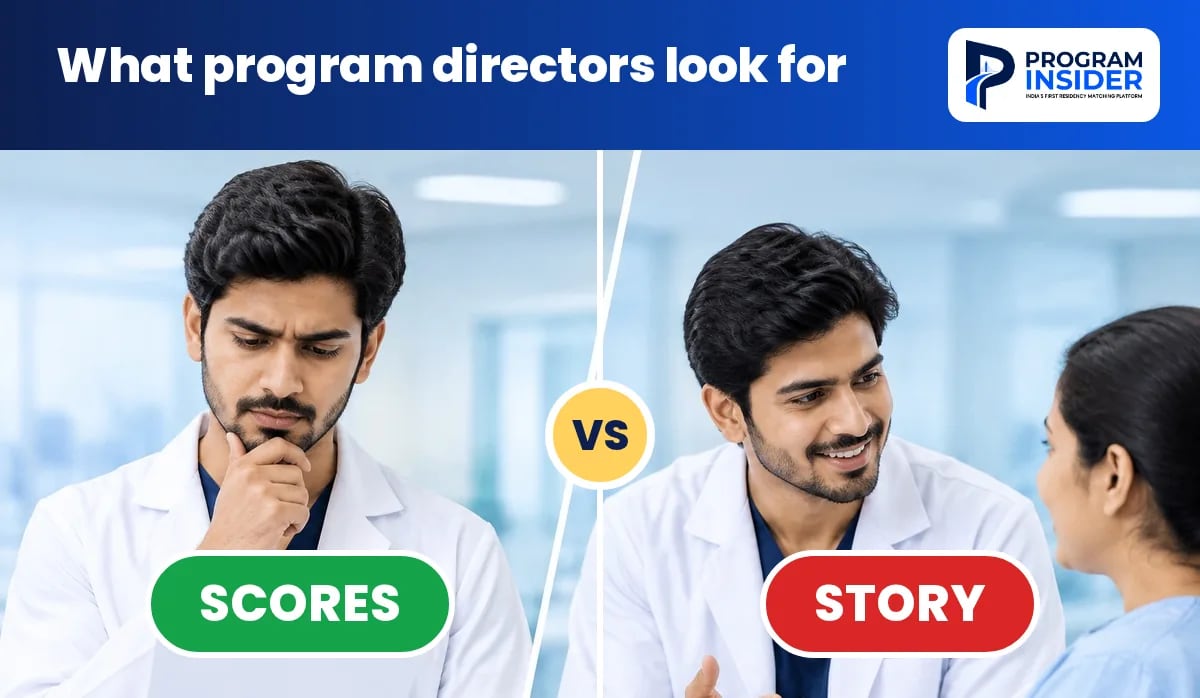
Quick answer: Strong USMLE scores open the door, but residency programs pick people they trust to work with patients at three in the morning. Beyond scores, they weigh US clinical experience, detailed letters, clear communication, professionalism, an honest personal statement, scholarly work, visa readiness and calm interview answers.
Every season, International Medical Graduates (IMGs) with solid Step 2 CK scores still finish Match Week without an offer. It feels confusing when you worked hard for that three digit number. The reason is simple. Exams test what you know on a screen, not how you care for a ward.
Program directors have hundreds of files that look alike on paper. Once scores clear an initial check, they look for clues about your daily habits. Will patients understand you? Will nurses trust your calls? Will you finish training on time?

Why good scores alone are not enough
A score shows you can study and pass a test. It does not prove you know how US hospitals run or how to handle a busy clinic. That is why programs read the rest of your file so closely.
The 2026 NRMP Match results show how tight the race is for IMGs. Out of 11,944 active non-US citizen IMGs, 56.4% matched to a PGY-1 spot. For US citizen IMGs, 70.0% matched.
| Applicant group | PGY-1 match rate | What it means for you |
|---|---|---|
| US MD seniors | 93.5% | Trained inside US hospitals |
| US DO seniors | 93.2% | Familiar system and letters |
| US citizen IMGs | 70.0% | No visa barrier, USCE still matters |
| Non-US citizen IMGs | 56.4% | Every non-score piece counts |
Do not guess what programs in your specialty weigh most. Read the official NRMP match data reports on nrmp.org, including the Program Director Survey and Charting Outcomes. Also read our guide on why IMGs get rejected despite good USMLE scores.
US clinical experience and strong letters
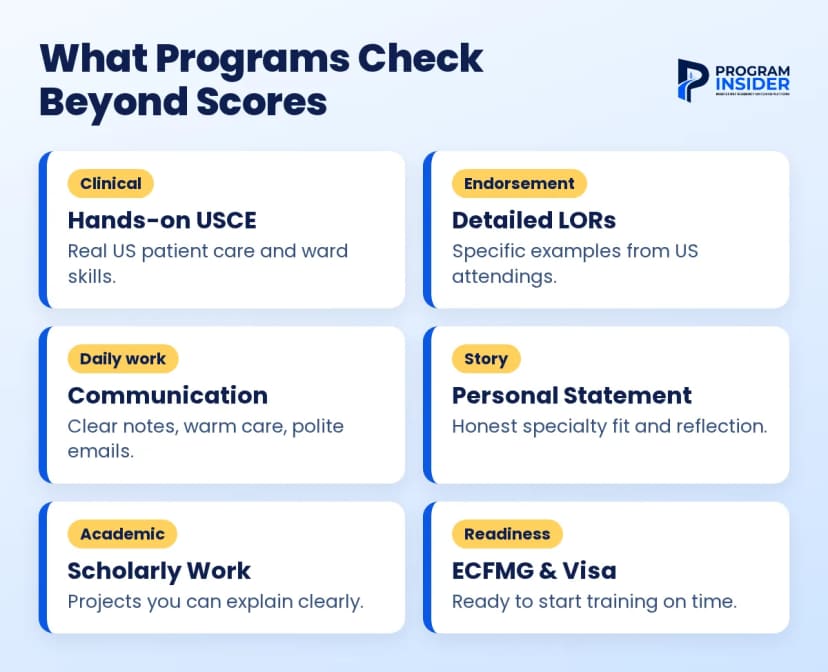
For IMGs, US clinical experience (USCE) is often the biggest separator after exams. Programs want to know you have worked inside a US clinic or hospital, learned electronic notes and talked with US patients.
Hands-on electives or externships usually beat passive observerships. When an attending watches you take a history and present on rounds, their letter carries real weight. A short note saying you watched quietly from the corner does very little.
In MyERAS, you can assign up to four letters of recommendation (LORs) to each program, as the ERAS letter writer guide explains. Your writers upload letters directly through the AAMC Letter Writer Portal. Any unfilled requests created before June 2026 must be sent again.
Note that dermatology, integrated plastic surgery and urology use standardized letters. For other specialties, ask US attendings who saw your clinical work closely. You can browse verified US clinical rotations and filter them by LOR type, specialty, state and setting.
Example: An example applicant, Priya, finishes two four-week rotations. On her first rotation, she stays silent during rounds and asks for a letter on day twenty-six. On her second, she arrives early, pre-rounds on two patients and asks for weekly feedback. Only the second attending can write real details about her clinical thinking.
Notice the word strong in that email. It gives the doctor an honest way out if they cannot write a good letter. Read more in our guide on strong letters of recommendation from US rotations.
Communication and day to day professionalism
Communication starts long before interview day. Coordinators and faculty notice how you write emails, fill forms and speak with clinic staff. A rude or pushy message to a coordinator can quietly end your chance at a program.
For ECFMG certification in the 2027 Pathways, you also need OET Medicine. The bar is at least 350 in Listening, Reading and Speaking, and 300 in Writing, all in one sitting, per ECFMG Pathways. Passing OET proves basic English readiness, yet programs listen for warmth, clarity and active listening too.
- Sending copy-paste emails asking for interviews before review starts.
- Talking over nurses or medical assistants during busy clinic hours.
- Blaming other team members when a task or note is missed.
- Giving long, unfocused patient summaries during morning rounds.
- Writing brief, polite messages only when you have a real update.
- Learning staff names and helping keep clinic flow smooth.
- Owning a mistake quickly and sharing how you fixed it.
- Presenting a crisp one-line summary, key vitals and a clear plan.
Your personal statement and ERAS story
Many IMGs treat the personal statement as a formal essay full of big words. Program readers scan dozens of statements in one evening. They want a clear voice that shows why you fit their specialty and how you think.
Example: Compare two openings for an internal medicine personal statement. Weak version: "Since childhood, I have dreamed of healing humanity. I want to discover the mysteries of internal medicine". Strong version: "During my internship ward week, I followed an elderly farmer with recurring heart failure. Nobody had asked who cooked his meals at home."
The second version shows curiosity, empathy and clinical focus in one sentence. Keep your statement under one page, explain any gaps honestly and tailor a paragraph when you apply to a specific track. If you need structured help, see our personal statement services or read how to write a strong personal statement.
Make sure your ERAS CV matches your statement too. Use action verbs and plain results in every experience box. Our ERAS CV guide breaks down how to write crisp entries.
Build a complete file beyond your scores
Get a clear step by step roadmap covering rotations, letters, ERAS editing and interview practice with our Complete Match Plan, or browse verified US clinical rotations today.
Research, scholarly work and program signals
You do not need ten published papers to match in most core specialties. Still, real scholarly work shows curiosity and follow-through. One finished poster or case report you can explain well beats five unfinished projects.
For the 2027 season, ERAS replaced the old publications tab with a redesigned Scholarly Work section, as reported on ERAS 2027 changes. Old entries did not auto-import, and applicants can mark up to three works as most meaningful. Pick works where you actually did the chart review, analysis or writing.
Program signals also show genuine interest when used carefully. On the AAMC program signaling page for 2027, Internal Medicine has 3 gold and 12 silver signals, while General Surgery has 15 signals. A signal tells a program you truly want to train there, though it never promises an interview.
- Check signal counts for your specialty each season before building your list.
- Save gold signals for realistic programs that sponsor your visa and match your profile.
- Skip mass-applying to programs whose basic requirements you do not meet.
- Prepare a two-sentence summary for every project listed in Scholarly Work.
Visa status and ECFMG readiness
Programs want residents who can start orientation on time without last-minute credential delays. That makes ECFMG certification and visa clarity practical ranking factors, not side notes.
To earn ECFMG certification, you need a qualifying medical school and passes on Step 1 and Step 2 CK. You also need primary source verification of your diploma and transcript, plus a Pathway and OET Medicine. For 2027 Pathways, the application deadline is 31 Jan 2027 ET, and OET scores must arrive directly by that date.
Visa rules also shape where you should apply. ECFMG, now part of Intealth, is the only sponsor for the J-1 physician visa, which carries a two year home country rule unless waived. Some programs sponsor H-1B instead, though a $100,000 payment rule for certain new petitions announced in September 2025 is in flux. Always check the current status with the program and an immigration lawyer.
- Pass Step 1 and Step 2 CK before ERAS opens for review
- Complete MyIntealth account and primary source verification early
- Pass OET Medicine in one sitting and submit your Pathway on time
- Collect three to four strong US letters uploaded by your writers
- Verify visa sponsorship on each target program's official site
- Upload your MSPE and medical school transcript before September review
The residency interview: where ranks shift
Your scores and ERAS packet earn the interview. Once you are on the video call, every applicant in that room has already met the program's paper bar. From there, interviewers ask one quiet question: do we want this person on our team for three years?
Prepare short, natural stories instead of memorizing speeches. Use a simple three-part structure for behavioral questions: the situation, what you did and what changed. Keep answers around one minute so the conversation feels two-way.
Example: Suppose an interviewer asks about a gap year after graduation. Weak answer: "I just stayed home studying for exams. The process takes a long time". Strong answer: "After internship, I spent four months passing Step 2 CK. Then I completed two US outpatient rotations and volunteered at a community clinic while finishing my ECFMG paperwork."
The strong answer sounds honest, structured and active. Ask two thoughtful questions at the end that show you read about their hospital. For deeper practice, read how to crack a residency program director interview and explore our residency interview preparation for IMGs.
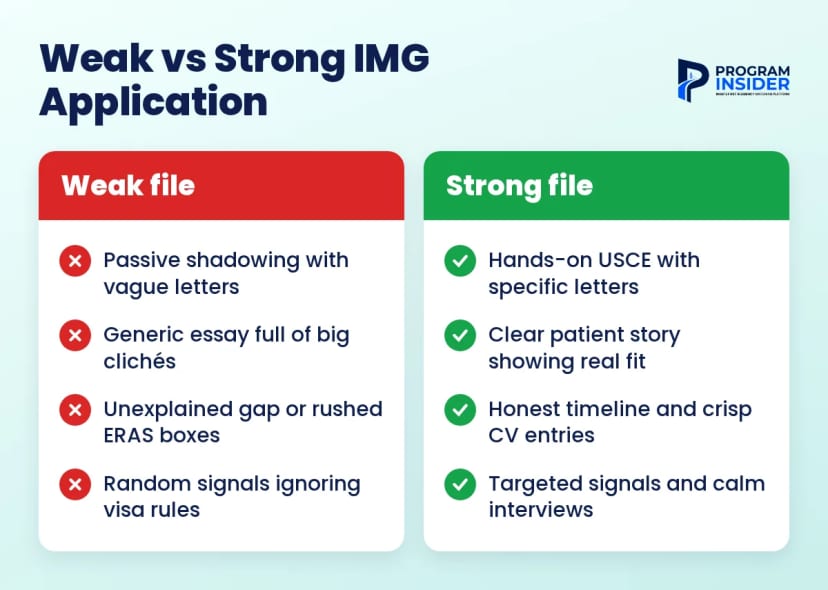
Common non score mistakes and your action checklist
Most avoidable rejections happen because applicants pour all their energy into exams and rush everything else in August. Fix these five gaps early so your whole file matches the effort you put into your scores.
Waiting too late for USCE
Booking rotations in September leaves no time for writers to upload letters before programs start reviewing applications.
Submitting generic letters
Letters from home faculty who barely saw your clinical work add little compared to specific US attending letters.
Hiding gaps or exam retakes
Dodging a timeline gap makes reviewers wonder what happened. Explain it briefly, show what you learned and move on.
Ignoring program filters
Applying blindly to hospitals that do not sponsor your visa wastes ERAS fees and scarce signals.
Skipping mock interviews
Reading sample answers in your head is not the same as speaking clearly on camera under time.
Turn your hard work into a complete Match application
Share your exam timeline, rotation goals and target specialty with our team. Explore our Complete Match Plan or book hands-on US clinical rotations to strengthen every part of your file.
Sources
- NRMP: 2026 Match by the numbers
- NRMP: Match data and reports
- AAMC: ERAS letter writers
- The DO: ERAS changes for the 2027 season
- AAMC: Program signaling, 2027 season
- ECFMG: Certification Pathways
- ECFMG: Certification
- US Department of State: J-1 Physician program
Last checked on 25 November 2026. Plans, examples and sample messages are our general advice, not official rules. Dates and fees can change, so check the official source before you act. No provider can guarantee a letter, an interview or a Match.