Quick answer: Select programs by filtering first and ranking second. Cut out programs that cannot take your visa or your profile. Then sort what is left into reach, match and safety, set a size that fits your ERAS budget, and track every program in one sheet.
Most IMGs start with a list from the internet and apply to all of it. That wastes money and time. A better way is a method you can repeat. This guide gives you the filters, the balance, the fee maths and a tracking sheet.

Why a list is not a strategy
A list tells you where programs are. It does not tell you which ones fit you. Two applicants with the same list can need very different programs, because their visa, scores and clinical experience differ.
The numbers show why care matters. In the 2026 Match, the PGY-1 match rate was 70.0% for US citizen IMGs and 56.4% for non-US citizen IMGs, as the NRMP results show. A careful list is one of the few parts you control.
| Group | Match rate | Note |
|---|---|---|
| US MD seniors | 93.5% | Highest group |
| US DO seniors | 93.2% | Close behind |
| All applicants | 79.8% | Whole pool |
| US citizen IMGs | 70.0% | 4,210 active |
| Non-US citizen IMGs | 56.4% | 11,944 active |
Please read these as a reason to plan, not to worry. NRMP also publishes deeper reports, and you can read them on the NRMP data page. We do not quote them here, so use the official site for details.
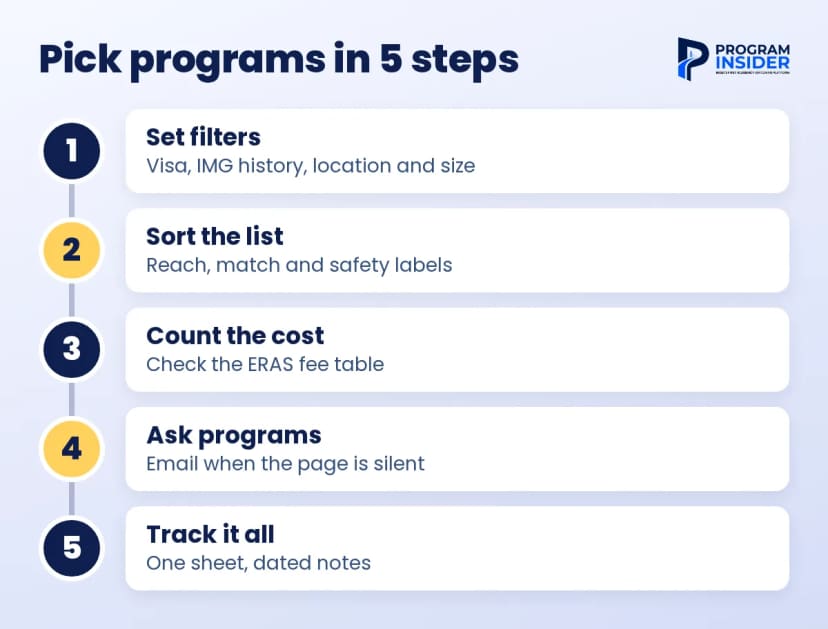
Step 1: Set the filters that cut the list
Filters come before everything else. Each one removes programs that would waste your fee. Work in this order, because the first filters are hard stops and the later ones are choices.
- Check visa first. ECFMG is the only J-1 sponsor for foreign doctors, and J-1 carries a two year home country rule unless waived. Some programs sponsor H-1B, so ask each one.
- Look for IMG history. Read the program page for current or past IMG residents, and look at where they trained. A program with no IMGs may still take you, but ask.
- Match the USMLE use to your profile. Programs describe how they use Step results on their own sites. Read that text and do not guess.
- Pick locations you can live in. Think about cost of living, family, language and distance from airports.
- Look at program size. Small programs may fill fast with fewer seats. Large programs have more seats but can get many applications.
Hold the visa rule tight. The H-1B picture is in flux, since a $100,000 payment rule for certain new petitions was announced in September 2025. Check the current status with the program and an immigration lawyer, and use the J-1 physician page for J-1 basics.
- Apply because the city is famous, without checking whether the program has ever taken an IMG or sponsors your visa type.
- Trust a forum post about a program and skip the official program page, which may have changed this year.
- Read the program page for visa and IMG statements, write down what you found, and email the coordinator when the page is silent.
- Use a dated note for each program, so you know when you checked and can recheck before you submit.
Step 2: Balance reach, match and safety
After the filters, you still have too many programs. Now sort them. A reach program is a long shot for your profile. A match program fits you well. A safety program is where your fit is clearly strong, such as a program with many IMG residents and your visa type.
A common mistake is a list that is all reach. Another is a list that is all safety, which can leave you under-placed. Aim for a spread. We do not give a fixed split, because it depends on your specialty and profile. Ask for a review of your list.
| Type | What it means | How to spot it |
|---|---|---|
| Reach | Strong program or tight fit for your profile | Few IMGs, higher expectations, no visa help |
| Match | Good fit on most filters | Some IMG residents, visa fits, location works |
| Safety | Best fit for your profile | Many IMG residents, visa clear, mixed background welcome |
| Unknown | Cannot tell yet | Email the program or leave it off |
Example. Here is an example: Priya is an Indian graduate with a pass on both Steps, four months of US clinical experience (USCE) and a need for a J-1 visa. She drops every program that says no visa support. Of the rest, she marks three famous university programs as reach, many community programs with IMG residents as match, and a few small IMG friendly programs as safety. Her list now has a reason for every row.
Want a list built for your profile?
Our team can review your filters and balance on a call. See our program shortlisting service or the IMG friendly program list to start.
Step 3: Decide how many programs to apply to
There is no honest magic number. The size of your list depends on your specialty, your profile and your budget. What we can do is show you the cost, so you choose with open eyes. The ERAS fee table charges per program, counted per specialty.
| Programs | ERAS cost | How it adds up |
|---|---|---|
| 30 | $330 | 30 programs at $11 each |
| 50 | $930 | Same 30, then 20 at $30 each |
| 100 | $2,430 | Same 30, then 70 at $30 each |
| 150 | $3,930 | Same 30, then 120 at $30 each |
See the jump after program 30. Each program from 31 on costs more than twice the earlier ones. So ask a hard question about each extra program: would I truly go there? If the answer is no, it does not belong on the list.
Example budget. This is an example Say you apply to 50 programs. ERAS costs $930. Add the USMLE Step 1 and Step 2 CK fees of $1,390 and the four main ECFMG fees of $1,855. The total is $4,175, before travel, interviews and visa costs. Plan this before you send applications, not after.
Also count the second costs. A bigger list can bring more interviews, and interviews cost time and money. Do not apply to more programs than you can prepare for, because each interview needs your best answers.
Step 4: Use signals and letters on the right programs
Signals tell a program you are truly interested. A gold signal says: you are in my top three. Use it where you would truly go. For the 2027 season, Internal Medicine had 3 gold and 12 silver, and Anesthesiology had 5 gold and 10 silver, per the AAMC signal page.
Numbers change each season, so check your specialty page. A signal does not promise an interview. Read our blog on how to use program signals for the next steps. Also plan letters early, since up to four letters can be assigned to each program.
Step 5: Build a tracking sheet
A tracking sheet saves you from mistakes. Make one row for each program and one column for each fact. Update it every time you learn something new. Keep the sheet simple, so you will actually use it.
| Column | What to write | Why it helps |
|---|---|---|
| Program and city | Name, state and specialty | Keeps the list clean |
| Type | Reach, match or safety | Shows your balance |
| Visa | J-1, H-1B or none, with the date you checked | Avoids wasted fees |
| IMG history | Names or years you found | Supports your type label |
| Signal | Gold, silver or none | Tracks where you showed interest |
| Status | Applied, interview, rejected | Helps you plan prep |
Add a column for notes after each email or call. One line is enough. If a coordinator says they do not sponsor visas, write that and the date. You will thank yourself in February when you fill your rank order list.
Step 6: Ask programs the right questions
When a program page is silent, ask. A short polite email costs nothing. Ask only what you cannot find yourself, and keep it to two questions. Send it from your professional email.
If you get no reply, move on. Do not send three more emails. Use the time to improve other parts of your file, such as your personal statement and your ERAS CV.
Timeline: when to do each step
For the 2027 season, MyERAS opened on 4 June 2026 and programs began review on 23 September 2026. The 2028 dates are not published yet. They usually follow a similar pattern, so check AAMC before you plan. Work backward from the date you plan to submit.
8 weeks before submit: Filters
- Write your visa need and list the filters you will use.
- Check your Step and USCE status, and note any gaps.
6 weeks before: First pass
- Collect programs from official pages and our lists.
- Drop every program that fails a hard filter.
4 weeks before: Sort
- Label each program reach, match or safety.
- Add the ones you cannot judge to an ask list.
3 weeks before: Ask
- Send short emails to coordinators on the ask list.
- Record every answer and the date in your sheet.
1 week before: Budget
- Count programs and compare the ERAS fee table.
- Pick where your signals go, if your specialty has them.
Mistakes that cost IMGs the most
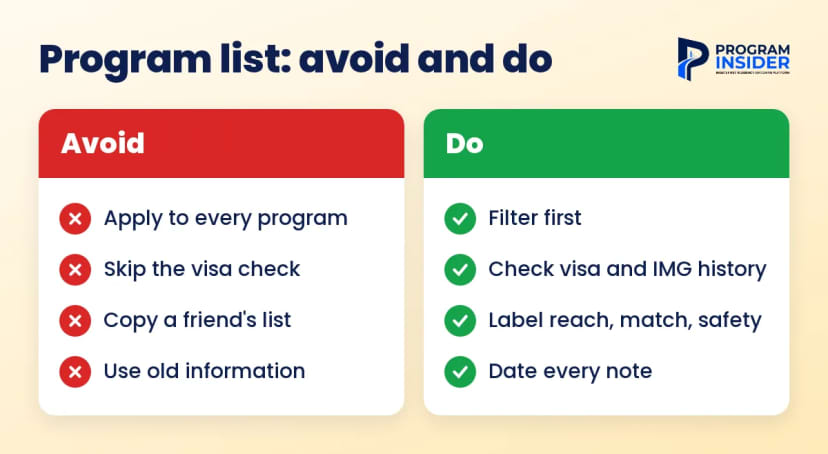
Applying to every program
A huge list feels safe, but from program 31 on each one costs more than twice as much. Use filters first, and keep only programs where you would truly go.
Skipping the visa check
A program that cannot sponsor your visa will not help you, however good it looks. Check the page and ask the coordinator before you pay the fee.
Copying a friend's list
Your friend has a different visa, score and experience. Use their list for ideas only, then run every program through your own filters.
Trusting old information
Program rules change each season. A blog post from two years ago may be wrong now. Write the date you checked on every row of your sheet.
A list with no safety programs
If every row is a reach, you carry all the risk. Add programs where your visa, background and location fit clearly, even if they are less famous.
Spending signals without thinking
A signal is limited. Spread it over programs you would truly rank, not over famous names you would never visit. Check the AAMC page for your specialty count.
- Built from one internet list and never checked on the program pages, so some programs may not take your visa.
- No labels, so you cannot say how many reach, match or safety programs you have, or why each is there.
- Every program has a dated visa note, an IMG history note and a type label in one tracking sheet.
- The size fits the ERAS fee table and your budget, and the signals go only to programs you would rank high.
- Your tracking sheet with filters and dates filled in.
- Your ECFMG details and ERAS ID in one safe note.
- Your Step results and transcript status, checked on the official sites.
- A budget note with the ERAS fee for your list size.
- Letter writers confirmed in the AAMC Letter Writer Portal.
If you also need a full plan, see our complete Match plan. For a deeper read on sorting programs, try our blog on how to shortlist residency programs. It adds a worked list, while this guide gives the full method.
Build your program list with our team
Program Insider can help you filter, sort and size your list with our program shortlisting service. If you want real US experience on your file, see our US clinical rotations.
Sources
- NRMP: 2026 Match by the numbers
- AAMC: ERAS fees
- AAMC: Program signaling, 2027 season
- US Department of State: J-1 Physician program
- NRMP: Match data and reports
Last checked on 25 November 2026. Plans, examples and sample messages are our general advice, not official rules. Dates and fees can change, so check the official source before you act. No provider can guarantee a letter, an interview or a Match.