Quick answer: You do not need a US contact to get a rotation. Pick your specialty and setting, use verified listings, prepare your documents, send a short request and follow the host's process. Avoid anyone who sells letters or promises a seat before you ask questions. Start four to six months before you want to go.
Most international medical graduates (IMGs) do not have a doctor in the US who can open a door. That is normal. What you do have is time, a clear plan and the ability to ask clean questions. Those three things are enough to start.
This guide shows each step, in order. It also shows how to avoid fake offers, which hurt many IMGs every year. If you want to see the types of rotations first, read our post on how to choose the right US clinical rotation.

Step 1: pick your specialty and setting first
Do not send requests until you know what you want. A request that says "any specialty, any place" gets ignored. Pick one main specialty and one backup. Then pick a setting, such as a hospital, a clinic or a private practice. Each one feels different.
Next, think about why. Do you want a letter of recommendation (LOR), a feel for US hospitals, or both? Your answer changes what you ask the host. Our post on planning rotations helps you set the goal before you spend money.
Example: Nida wants internal medicine. She has one month free in spring. She picks internal medicine as the main specialty and family medicine as the backup. She wants a setting where she can see patients with a supervising doctor and ask for a letter at the end. That clear list makes her search short.
Step 2: use verified listings, not random messages
Without a contact, the best place to start is a list where hosts have posted their rotations and their rules. Our rotations page has filters for LOR type, specialty, state, setting and price. This saves you from cold messaging a hundred strangers.
Check each listing for the same basics. Who is the host? What will you do each day? How long is it? What does it cost? Will you get a written confirmation? If a listing cannot answer these, skip it.
Be careful about VSLO. It is run by AAMC and is only for current students at participating home schools. Graduates cannot use it. The fee is about $18 per elective application. If you have already graduated, use other host processes.
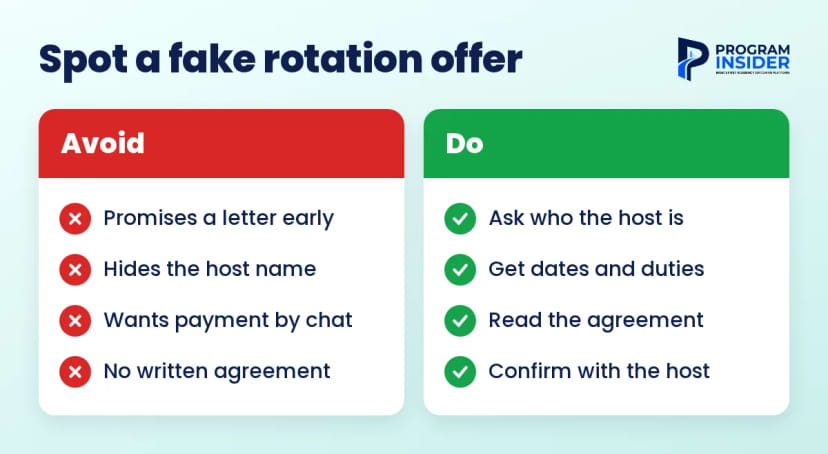
- Promises a letter or a seat before you ask anything, and gives no name for the host.
- Gives no written details of the daily work and asks you to pay through a private chat.
- Names the host, the department and the type of experience, and explains the process in writing.
- States the dates, the cost and what you will receive, so you can compare options calmly.
Step 3: prepare your documents before you apply
Hosts often ask for the same set of papers. If you have them ready, your reply time drops from weeks to days. Build one folder on your computer and keep each file clearly named.
- A one or two page CV with your school, graduation date and any clinical work.
- A scan of your medical degree or a letter that proves your student status.
- Your vaccine and health records, since many hosts ask for them.
- Proof of your Step exams or ECFMG status, if you have taken them.
- A passport style photo and a copy of your passport.
- Proof of health insurance and any cover the host asks for.
Every host sets its own list. Ask for it in your first email so you do not guess. Our CV guide helps you write a clean CV that you can reuse later for residency.
Find a verified rotation
Browse our rotations listing and filter by specialty, state and price. Not sure which one fits? Our services page shows how our team can help.
Step 4: write a short, polite request
A good request is short. It says who you are, what you want, which dates you have and what you can send. It does not tell your life story or ask for favors. Make it easy to say yes or to say no.
Example: Before sending, Nida cuts one line that said "I will work very hard". It says nothing the coordinator can check. She replaces it with one line about her four months of ward duty at home. Short and real beats long and flowery.
Step 5: follow the host process exactly
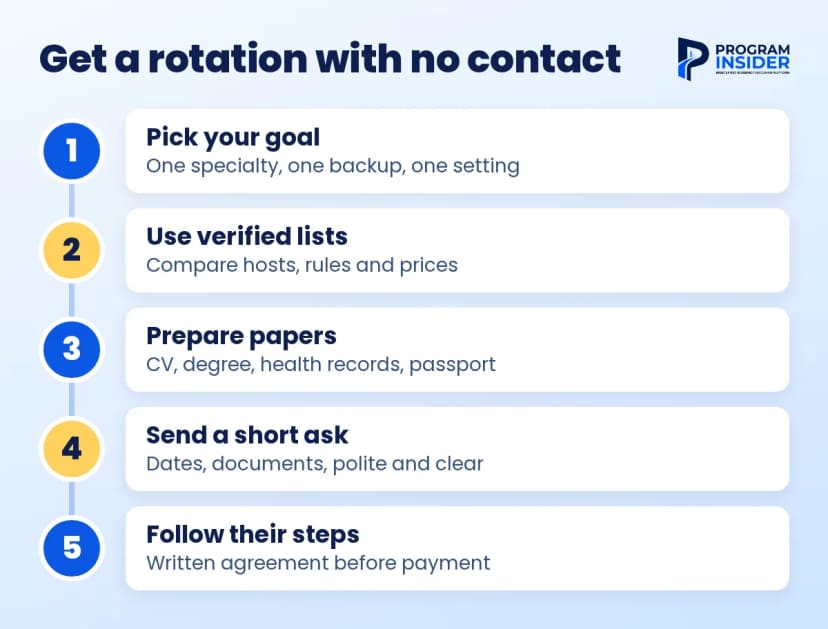
Once a host replies, do what they ask, in the order they ask. Send the files they request in the format they request. Do not send extra papers. Do not call and email the same day. Hosts are busy, and people who follow rules look easy to work with.
- Reply within one working day, even if you only say you got the message.
- Send each document with a clear file name, such as your name and the document type.
- Ask for the written agreement and read it before you pay anything.
- Confirm dates, duties and who your supervisor is, in writing.
- Ask how and when you can request a letter and what it needs from you.
Example: A host sends Nida a form and asks for her degree copy by Friday. She sends it on Wednesday, with a file named "Nida Khan degree". She does not attach her whole portfolio. The coordinator sees a clean, simple reply and moves her to the next step.
If you need a visa or other travel papers, ask the host what they can and cannot provide. Do not assume. The official page for J-1 physicians is the US State Department J-1 physician page, and rules change often.
What to avoid: fake offers and unlicensed sellers
Paying before you see a written agreement
A real host can write down the dates, duties and cost. If someone pushes you to pay by private chat before you see this, stop and ask for the agreement first.
Believing a promise of a letter
No honest seller can promise a letter before you work. A letter comes from a doctor who knows your work. Our post on strong letters of recommendation explains how to earn one.
Trusting a seller who hides the host
If a company will not tell you which hospital or clinic you will join, you cannot check anything. Ask for the host name and confirm it with the host yourself.
Mass emailing a hundred strangers
Copy and paste emails look careless. Send fewer, better requests to hosts that match your specialty and dates, and keep a simple sheet of who you wrote to.
Ignoring the type of experience
Observing, a hands-on clerkship and a telerotation are not the same. Read our post on observership vs hands-on clerkship before you choose.
A simple timeline from today
Months 6 to 5 before: plan
- Pick your specialty, backup, state and setting.
- Set a budget for the rotation, travel and stay.
Months 5 to 4 before: search
- Use verified listings and shortlist four to six hosts.
- Build your document folder and CV.
Months 4 to 3 before: ask
- Send your short request to each host.
- Track replies in one sheet and follow each host's process.
Months 3 to 1 before: confirm
- Sign the written agreement and book travel.
- Plan your letter request with your supervisor.
These month counts are our suggestion, not a rule. Some hosts take a short notice and some need much more. Always read the host's own timeline first.
Your checklist for the next two weeks
Start with real listings
Use our rotations listing to compare hosts by specialty, state, setting and price. If you want a full plan for residency, ask about our complete match plan.
Sources
- AAMC: Visiting Student Learning Opportunities
- US Department of State: J-1 Physician program
- ECFMG: Certification
- USMLE
Last checked on 25 November 2026. Plans, examples and sample messages are our general advice, not official rules. Dates and fees can change, so check the official source before you act. No provider can guarantee a letter, an interview or a Match.